Brian Roberts and Edward Roski Jr.: Careers, Businesses, and Their Paths to Success
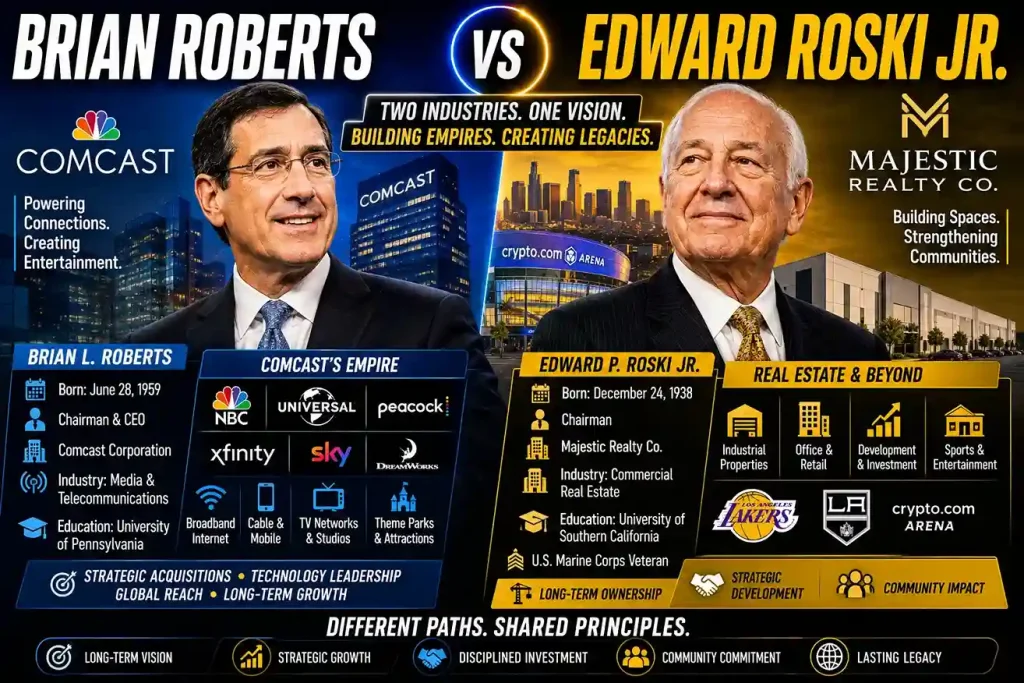
Brian Roberts and Edward Roski Jr. are two prominent American business leaders who built substantial careers in very different industries.
Roberts became a major figure in media and telecommunications through his leadership of Comcast. Roski built his reputation in commercial real estate through Majestic Realty Co. and expanded his interests into professional sports and entertainment.
Their businesses operate in different sectors, but both careers share several themes: long-term investment, strategic expansion, disciplined management, and large-scale business development.
Brian Roberts: Profile and Background
Brian L. Roberts is an American business executive best known for his long leadership role at Comcast Corporation.
| Detail | Information |
|---|---|
| Full Name | Brian L. Roberts |
| Born | June 28, 1959 |
| Nationality | American |
| Profession | Business Executive |
| Company | Comcast Corporation |
| Position | Chairman and CEO |
| Industry | Media and Telecommunications |
| Education | University of Pennsylvania |
Roberts grew up in Philadelphia, where his father, Ralph Roberts, founded Comcast in 1963 as a small cable television business.
Rather than immediately taking control of the company, Brian Roberts gained experience across different areas of the organization. His exposure to operations, finance, customer service, and acquisitions helped prepare him for senior leadership.
Brian Roberts and the Rise of Comcast
Roberts became president of Comcast in 1990 and later took on the roles of chairman and chief executive.
Under his leadership, Comcast expanded far beyond its original cable television business.
The company’s growth involved major transactions and investments, including:
- AT&T Broadband
- NBCUniversal
- Sky
- DreamWorks Animation
These developments helped transform Comcast into a diversified company with interests across communications, entertainment, media, and technology.
Comcast’s Expanding Business
Comcast’s operations have included several major areas:
- Broadband internet
- Cable television
- Wireless services
- Television networks
- Film production
- Streaming
- Theme parks
This diversification became an important part of Roberts’ long-term corporate strategy.
Instead of relying on traditional cable services alone, Comcast expanded into businesses connected with content, connectivity, entertainment, and digital technology.
Brian Roberts’ Business Strategy
Roberts’ career is closely associated with long-term corporate expansion.
His leadership approach has emphasized areas such as:
- Strategic acquisitions
- Technology investment
- Broadband infrastructure
- Media ownership
- Customer services
- Business diversification
Large acquisitions allowed Comcast to expand its capabilities and enter markets beyond traditional cable television.
This strategy also created a much broader business portfolio than the company had when Roberts first entered senior leadership.
Brian Roberts’ Wealth
Roberts’ financial interests are strongly connected with Comcast.
His wealth has been associated with:
- Comcast shares
- Executive compensation
- Investment holdings
Because the value of publicly traded shares changes over time, estimates of his personal wealth can also change.
For that reason, a fixed net-worth figure should not be treated as permanent.
Edward Roski Jr.: Profile and Background
Edward P. Roski Jr. is an American real estate developer and businessman best known for his leadership of Majestic Realty Co.
| Detail | Information |
|---|---|
| Full Name | Edward P. Roski Jr. |
| Born | December 24, 1938 |
| Nationality | American |
| Profession | Real Estate Developer |
| Company | Majestic Realty Co. |
| Position | Chairman |
| Industry | Commercial Real Estate |
| Military Service | U.S. Marine Corps |
| Education | University of Southern California |
Roski’s career developed primarily around commercial property and large-scale real estate development.
His interests eventually expanded beyond property into professional sports and entertainment-related projects.
Edward Roski Jr. and Majestic Realty
Majestic Realty Co. became one of the major privately held commercial real estate businesses in the United States.
The company’s activities have included development involving:
- Distribution centers
- Warehouses
- Office buildings
- Retail properties
- Business parks
- Sports facilities
Industrial and logistics properties became particularly important areas of the company’s business.
Long-term property ownership and leasing have played an important role in the company’s development.
Edward Roski Jr.’s Real Estate Strategy
Roski’s approach differs substantially from Roberts’ technology and media strategy.
His business interests have centered on physical assets that can generate value through development, leasing, and long-term appreciation.
Important elements include:
- Strategic property acquisition
- Industrial development
- Commercial leasing
- Long-term ownership
- Land development
- Diversification
This model requires patience because major real estate projects can take years to develop and generate their full economic value.
Edward Roski Jr. and Professional Sports
Roski also became involved in professional sports and entertainment.
His business interests have included associations with major Los Angeles sports organizations and venue development.
Sports investments provided another dimension to his business portfolio beyond commercial property.
His involvement in stadium and entertainment proposals also reflected his broader interest in combining real estate development with sports and tourism.
Brian Roberts vs. Edward Roski Jr.
Although both men built major businesses, their primary areas of expertise are very different.
| Category | Brian Roberts | Edward Roski Jr. |
|---|---|---|
| Primary Industry | Media and Telecommunications | Commercial Real Estate |
| Main Company | Comcast | Majestic Realty Co. |
| Business Role | Chairman and CEO | Chairman |
| Core Assets | Media, Communications and Technology | Commercial Properties |
| Expansion Strategy | Acquisitions and Technology | Property Development and Ownership |
| Additional Interests | Entertainment and Media | Sports and Entertainment |
| Main Business Base | Philadelphia | Los Angeles |
The contrast between them shows how large businesses can be built through very different investment models.
Roberts expanded through corporate acquisitions and technology infrastructure.
Roski expanded through property development, commercial leasing, and strategic real estate investments.
How Brian Roberts and Edward Roski Jr. Built Their Businesses
The careers of Brian Roberts and Edward Roski Jr. show two different approaches to building long-term wealth.
Roberts expanded a communications company by combining infrastructure, media, technology, and strategic acquisitions.
Roski developed physical assets through commercial real estate, property ownership, and long-term development.
Although their industries differ, both relied on patient capital and large-scale investment.
Brian Roberts’ Approach to Corporate Growth
Comcast’s expansion under Roberts involved more than simply increasing its customer base.
The company moved into businesses that complemented its communications operations.
Strategic Acquisitions
Major acquisitions helped Comcast build a broader portfolio.
The expansion into NBCUniversal, for example, connected Comcast’s distribution infrastructure with television networks, film production, entertainment properties, and other media assets.
The acquisition of Sky also expanded Comcast’s international presence.
This strategy created a business with interests across both connectivity and entertainment.
Technology Investment
Technology became another important part of Comcast’s growth.
Broadband infrastructure, wireless services, streaming platforms, and digital products allowed the company to respond to changing consumer behavior.
The strategy reflected a broader shift from traditional cable television toward integrated communications and entertainment services.
Edward Roski Jr.’s Approach to Real Estate
Roski followed a more asset-focused model.
Commercial properties can provide recurring rental income while potentially appreciating over long periods.
His business interests have therefore emphasized acquiring and developing properties that can serve businesses and commercial tenants.
Industrial Real Estate
Industrial properties became an important component of Majestic Realty’s portfolio.
Distribution centers and logistics facilities benefit from demand created by manufacturing, transportation, warehousing, and commerce.
This type of development requires substantial capital but can provide long-term leasing opportunities.
Diversification
Roski also diversified beyond traditional commercial properties.
His interests have included:
- Sports
- Entertainment venues
- Office properties
- Retail developments
- Industrial facilities
- Large-scale development projects
This diversification helped connect his real estate activities with broader commercial and entertainment opportunities.
Business Strategy Comparison
| Strategy | Brian Roberts | Edward Roski Jr. |
|---|---|---|
| Core Investment | Media and Communications | Real Estate |
| Growth Method | Corporate Acquisitions | Property Development |
| Major Assets | Networks, Infrastructure and Entertainment | Commercial Properties |
| Revenue Model | Communications and Media Services | Leasing and Property Development |
| Diversification | Technology and Entertainment | Sports and Commercial Development |
| Time Horizon | Long-Term Corporate Growth | Long-Term Property Ownership |
Their strategies differ, but both emphasize assets capable of producing value over many years.
Their Approach to Risk
Large-scale business expansion always involves risk.
Roberts faced risks associated with acquisitions, technology changes, competition, and changing consumer behavior.
Roski faced different challenges involving property markets, development costs, tenant demand, financing, and economic cycles.
Roberts’ Business Risks
His major challenges include:
- Changing media consumption
- Streaming competition
- Technology disruption
- Large acquisition costs
- Telecommunications competition
Roski’s Business Risks
His industry involves:
- Property-market fluctuations
- Construction costs
- Interest rates
- Tenant demand
- Development timelines
- Commercial real estate cycles
Both careers demonstrate the importance of managing risk while maintaining a long-term strategy.
Sports and Entertainment: Where Their Interests Overlap
One interesting difference between Roberts and Roski is their connection to entertainment.
Roberts built entertainment interests through Comcast’s ownership of media businesses and NBCUniversal.
Roski became involved in professional sports and entertainment venues through his broader investment activities.
Their routes into entertainment were therefore different.
Roberts approached entertainment through media ownership and content. Roski approached it through real estate, sports, and physical venues.
Philanthropy and Community Involvement
Both business leaders have also been associated with philanthropic and community activities.
Roberts and Comcast have supported initiatives involving areas such as education, healthcare, community development, and technology access.
Roski has supported educational, medical, veterans, arts, and community causes.
Their charitable interests demonstrate how large business careers can extend into community involvement.
What Entrepreneurs Can Learn From Brian Roberts
Roberts’ career offers several lessons for entrepreneurs and business leaders.
Think Beyond the Original Business
Comcast began as a cable company but eventually developed interests across communications and entertainment.
Expansion into complementary industries can create additional growth opportunities when managed carefully.
Use Strategic Acquisitions
Acquisitions can provide access to new customers, technology, content, and markets.
However, large transactions require careful financial and operational planning.
Adapt to Technology
The communications industry changed dramatically as consumers moved toward broadband, mobile services, streaming, and digital media.
Businesses that adapt to those changes can remain competitive.
What Entrepreneurs Can Learn From Edward Roski Jr.
Roski’s career provides different lessons.
Think Long Term
Real estate development rarely produces instant results.
Projects often require years of planning, construction, leasing, and management.
Focus on Valuable Assets
High-quality commercial properties can provide recurring income while retaining long-term value.
Diversify Carefully
Roski expanded from traditional commercial property into sports and entertainment-related investments.
Diversification can reduce dependence on a single business segment when supported by relevant expertise.
Are Brian Roberts and Edward Roski Jr. Business Partners?
There is no documented business partnership between Brian Roberts and Edward Roski Jr. in the material provided.
They have developed their businesses independently.
Roberts is associated primarily with Comcast and its media and telecommunications operations.
Roski is associated primarily with Majestic Realty and commercial real estate.
Their industries may occasionally intersect through entertainment and sports, but that does not establish a direct partnership.
Are Brian Roberts and Edward Roski Jr. Related?
No family relationship is identified in the provided material.
They come from different business backgrounds and developed their careers independently.
Their names appear together because both are prominent American business leaders, not because of an established family connection.
Final Comparison
Brian Roberts and Edward Roski Jr. demonstrate two different models of American business success.
Roberts transformed Comcast from a regional cable business into a diversified communications and entertainment company through acquisitions, infrastructure investment, and technological expansion.
Roski built a major commercial real estate enterprise through property development, long-term ownership, leasing, and diversification into sports and entertainment.
Their careers differ in almost every operational respect, but both demonstrate the importance of long-term thinking, disciplined investment, strategic expansion, and adaptability.
Their stories show that successful businesses can be built around very different assets, whether those assets are media networks and communications infrastructure or commercial properties and development projects.