Tadashi Yanai and John Malone: Are the Uniqlo Founder and Media Mogul Connected?
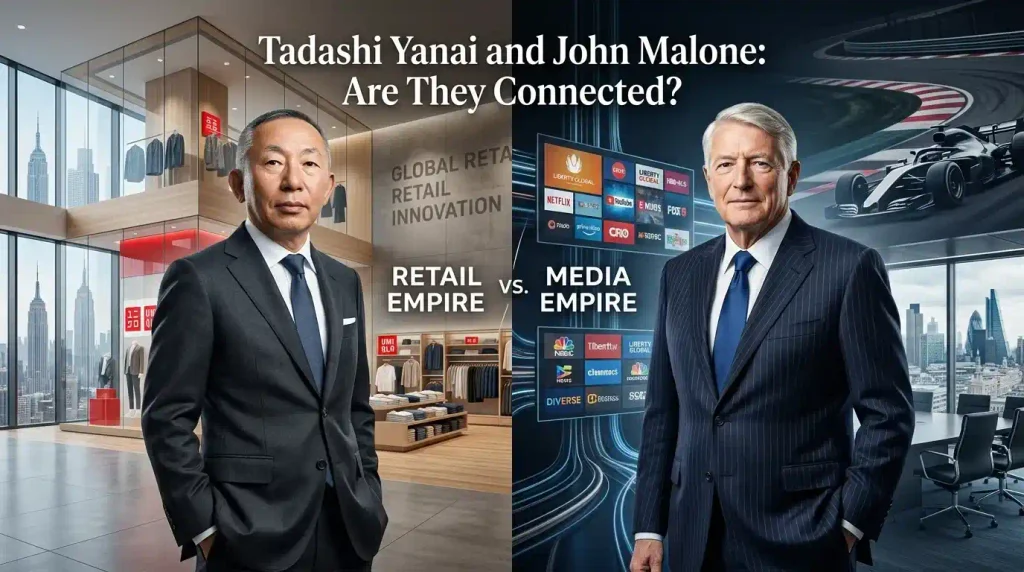
Tadashi Yanai and John Malone are two of the most influential business figures in modern global commerce. However, they built their fortunes in completely different industries.
Yanai transformed a Japanese clothing business into Fast Retailing, the global company behind Uniqlo. Malone built his reputation through cable television, telecommunications, media investments, and complex corporate transactions.
There is no widely documented business partnership or family relationship between Tadashi Yanai and John Malone. The names are better understood as a comparison between two billionaires who used very different strategies to build enormous business influence.
One built a consumer-facing global retail brand. The other built wealth through ownership, acquisitions, corporate structures, and long-term control of major media and communications assets.
Tadashi Yanai and John Malone at a Glance
| Detail | Tadashi Yanai | John Malone |
|---|---|---|
| Born | 1949 | 1941 |
| Nationality | Japanese | American |
| Main industry | Fashion and retail | Media and telecommunications |
| Best known for | Uniqlo and Fast Retailing | TCI and Liberty businesses |
| Business approach | Global consumer brand building | Acquisitions and capital allocation |
| Core strength | Retail, products and international expansion | Corporate finance and asset ownership |
| Major company | Fast Retailing | TCI and Liberty-related companies |
| Current notable role | Chairman, President and CEO of Fast Retailing | Chairman Emeritus of Liberty Media |
The comparison becomes more interesting when looking at how each man creates value.
Yanai depends on customers choosing products every day. Malone built his reputation by owning and controlling businesses that provide communication, media, and entertainment services.
Are Tadashi Yanai and John Malone Related?
No reliable public evidence shows that Tadashi Yanai and John Malone are related.
There is also no widely documented evidence that they are long-term business partners or that one built his business empire with the other.
Their names may appear together in searches because both are prominent billionaires and influential business leaders.
Their connection is primarily a comparison, not a personal or corporate partnership.
Who Is Tadashi Yanai?
Tadashi Yanai is the Japanese billionaire behind Fast Retailing, the parent company of Uniqlo.
He was born in 1949 and grew up around his family’s clothing business. After graduating from Waseda University, he joined the family business and eventually took over its operations.
His major achievement was recognizing that the clothing industry could be transformed through large-scale operations, standardized products, global sourcing, functional fabrics, and strong retail execution.
In 1984, the first Unique Clothing Warehouse store opened in Hiroshima. The name later became Uniqlo.
That business would eventually grow into one of the world’s largest apparel companies.
Today, Yanai remains Chairman, President and CEO of Fast Retailing. (Fast Retailing)
How Tadashi Yanai Built the Uniqlo Empire
Uniqlo’s strategy differs from many traditional fashion companies.
Rather than relying entirely on rapidly changing seasonal trends, the company focuses heavily on practical clothing designed for everyday use.
Its strategy includes:
- Basic clothing with broad appeal
- Functional materials
- Large-scale production
- Global sourcing
- Affordable pricing
- Strong inventory management
- International retail expansion
- Direct control over product development and sales
The company describes this broader approach through its LifeWear concept.
Products such as HEATTECH and AIRism helped Uniqlo establish itself as more than a basic clothing retailer. Functional technology became part of its product identity.
This model helped Fast Retailing compete globally against major retailers from Europe and the United States.
Fast Retailing’s Recent Growth
Fast Retailing has continued to report strong growth.
For the fiscal year ended August 2025, the company reported revenue of approximately ¥3.40 trillion and business profit of approximately ¥551.2 billion. Uniqlo operated 2,519 stores worldwide at that point. (Fast Retailing)
The company also reported record first-half results for fiscal 2026. Revenue for the six months ending February 2026 reached approximately ¥2.06 trillion, while business profit reached approximately ¥386.9 billion. Fast Retailing said growth was strong across several international markets, including North America and Europe. (Fast Retailing)
Fast Retailing’s latest FY2026 forecast, announced in April 2026, projected:
- Revenue of ¥3.9 trillion
- Business profit of ¥690 billion
- Operating profit of ¥700 billion
These are company forecasts rather than completed full-year results. (Fast Retailing)
For a U.S. audience, Uniqlo’s North American expansion is particularly important. Fast Retailing sees international growth as a major part of its long-term strategy, with North America playing a larger role in the company’s future.
Tadashi Yanai’s Business Philosophy
Yanai has built his career around global scale.
His strategy is not simply to operate successful clothing stores. His larger objective is to build a global apparel company capable of competing across major international markets.
Fast Retailing has publicly discussed a long-term target of reaching ¥10 trillion in annual sales. (Fast Retailing)
Yanai’s approach can be summarized through several principles:
Think Globally
Fast Retailing expanded far beyond Japan and now operates across Asia, Europe, North America, and other regions.
Focus on Everyday Products
Uniqlo aims to sell clothing that customers can use repeatedly rather than relying only on short-term fashion trends.
Build a Strong Operating System
The company maintains significant control over product development, sourcing, production coordination, retail, and distribution.
Reinvest for Growth
The business continues opening stores and expanding its international footprint.
Yanai’s empire was built around one major idea: scale a consumer brand across the world.
Who Is John Malone?
John Malone is one of the most influential figures in the history of American cable television and media.
Born in Milford, Connecticut, in 1941, Malone developed a highly technical academic background.
He earned a bachelor’s degree in electrical engineering and economics from Yale University. He later completed graduate studies at Johns Hopkins University, including a Ph.D. in operations research. (Liberty Media Corporation)
Before becoming a major media executive, Malone worked in engineering, consulting, and telecommunications.
His defining business opportunity came through Tele-Communications Inc., better known as TCI.
How John Malone Built TCI
Malone joined TCI during a difficult period in the company’s history.
He became President and CEO in 1973 and later served as Chairman and CEO. Over the following decades, TCI grew into one of the dominant cable television companies in the United States. (Liberty Media Corporation)
Malone’s approach differed sharply from Yanai’s.
Yanai built value by improving products and expanding retail operations.
Malone built value through:
- Acquisitions
- Financial restructuring
- Debt management
- Corporate control
- Scale
- Long-term ownership
- Strategic transactions
TCI eventually merged with AT&T in 1999.
That transaction became one of the defining deals of the American cable industry.
John Malone and the Liberty Business Empire
After TCI, Malone continued building influence through Liberty-related companies and investments.
His business interests have touched areas such as:
- Media
- Telecommunications
- Broadband
- Entertainment
- Sports
- International communications
Liberty Media became one of the best-known companies connected with Malone’s investment strategy.
However, an important recent change occurred in January 2026.
John Malone transitioned from Chairman of Liberty Media to Chairman Emeritus. Robert R. Bennett became Chairman of the Board. (Liberty Media Corporation)
That change matters because older articles may incorrectly describe Malone as the current Chairman of Liberty Media.
The more accurate 2026 description is Chairman Emeritus.
John Malone’s Formula One Connection
Formula One became one of the most visible assets associated with Liberty Media’s modern business strategy.
Liberty Media’s involvement in Formula One helped expand its presence in global sports and entertainment.
Malone has remained connected to Liberty Media even after moving into the Chairman Emeritus role. Recent SEC filings in 2026 also continue to identify him as a major reporting person connected with Liberty Formula One securities.
This reflects Malone’s broader business philosophy.
He has often focused less on creating consumer products and more on owning valuable platforms and assets.
Tadashi Yanai vs. John Malone
The biggest difference between Yanai and Malone is the way they create business value.
| Category | Tadashi Yanai | John Malone |
|---|---|---|
| Main strategy | Build and scale a global consumer brand | Acquire, structure, and control valuable businesses |
| Core industry | Fashion retail | Media and telecommunications |
| Main wealth engine | Fast Retailing ownership | Media and communications investments |
| Customer relationship | Direct relationship with shoppers | Ownership of companies and platforms |
| Expansion style | Stores and international markets | Acquisitions and corporate transactions |
| Business strength | Products and retail operations | Capital allocation and financial strategy |
| Major legacy | Building Uniqlo into a global brand | Transforming cable and media ownership |
Yanai built a global retail machine.
Malone built a business network.
Both created extraordinary wealth, but they used almost opposite strategies.
Product Builder vs. Capital Allocator
Tadashi Yanai is best understood as a product and retail empire builder.
His success depends on millions of consumers buying Uniqlo clothing.
John Malone is best understood as a capital allocator and corporate strategist.
His success has depended on identifying valuable assets, structuring ownership, managing capital, and participating in major corporate transactions.
Yanai asks:
What product will customers want to buy?
Malone asks:
What business or asset can create long-term value?
Both questions can create billion-dollar companies.
What Tadashi Yanai and John Malone Have in Common
Despite their major differences, the two businessmen share several important characteristics.
Long-Term Thinking
Neither built his business empire overnight.
Yanai spent decades expanding Fast Retailing from Japan into global markets.
Malone spent decades building TCI and later developing Liberty-related businesses.
Discipline
Both men are associated with strategic decision-making rather than purely speculative business models.
Global Influence
Yanai’s company sells clothing internationally.
Malone’s business influence has reached telecommunications, media, entertainment, and global sports.
Willingness to Change Strategy
Both leaders adapted as their industries changed.
Yanai moved a traditional Japanese clothing business toward global retail.
Malone moved through the evolution of cable television, telecommunications, media ownership, and entertainment.
Which Business Model Is More Powerful?
There is no simple answer.
Yanai’s model has one major advantage: a successful global consumer brand can generate massive recurring revenue.
Uniqlo benefits when customers around the world repeatedly buy its products.
Malone’s model has a different advantage: ownership of strategic assets can create significant value without requiring one single consumer brand to drive the entire business.
Yanai’s model depends heavily on:
- Consumer demand
- Product quality
- Supply chains
- Store performance
- Brand relevance
Malone’s model depends heavily on:
- Corporate valuation
- Capital allocation
- Strategic ownership
- Financial structures
- Major transactions
Both approaches involve risk.
Both can also create enormous long-term wealth.
Why Are Tadashi Yanai and John Malone Compared?
The names are interesting together because they represent two very different types of billionaire.
Tadashi Yanai represents the global retail entrepreneur.
John Malone represents the American media and investment strategist.
Their comparison shows that there is no single path to building a business empire.
One person can build wealth by selling millions of physical products.
Another can build wealth by owning companies, controlling assets, and making strategic deals.
Their careers also demonstrate the importance of choosing a business model that matches a leader’s strengths.
Latest Business Status
As of the latest available 2026 company information:
Tadashi Yanai remains Chairman, President and CEO of Fast Retailing. The company reported record first-half fiscal 2026 results and continued to project major full-year growth. (Fast Retailing)
John Malone is Chairman Emeritus of Liberty Media. He moved into that role effective January 1, 2026, while Robert R. Bennett became Chairman of the Board. (Liberty Media Corporation)
These updated roles are important because many older articles still describe Malone using his previous title.
Final Thoughts
Tadashi Yanai and John Malone are not known for a direct business partnership.
Their names belong to two separate business worlds.
Yanai built one of the world’s most important clothing companies by scaling Uniqlo internationally and focusing on functional everyday apparel.
Malone helped reshape American cable and media ownership through TCI and Liberty-related businesses, using acquisitions, financial strategy, and long-term asset control.
Their comparison offers a valuable business lesson.
Yanai built wealth by creating a global brand that millions of people use.
Malone built wealth by controlling and investing in businesses that influence major industries.
One is a retail empire builder.
The other is a corporate architect.
Both demonstrate how long-term strategy can create extraordinary business influence.
Frequently Asked Questions
Are Tadashi Yanai and John Malone related?
No. There is no reliable public evidence showing that Tadashi Yanai and John Malone are related.
Are Tadashi Yanai and John Malone business partners?
There is no widely documented public business partnership between them.
What is Tadashi Yanai famous for?
Tadashi Yanai is best known for leading Fast Retailing and building Uniqlo into a major global apparel brand.
What is John Malone famous for?
John Malone is best known for his leadership at TCI and his long involvement with Liberty-related media and telecommunications businesses.
Is John Malone still Chairman of Liberty Media?
No. John Malone transitioned to Chairman Emeritus effective January 1, 2026. Robert R. Bennett became Chairman of Liberty Media’s Board.
What is the biggest difference between Tadashi Yanai and John Malone?
Yanai primarily built a global consumer retail business, while Malone built wealth through telecommunications, media ownership, investments, acquisitions, and corporate strategy.
Why are Tadashi Yanai and John Malone searched together?
The pairing appears to reflect interest in comparing two influential billionaires from different industries rather than a documented family or business relationship.