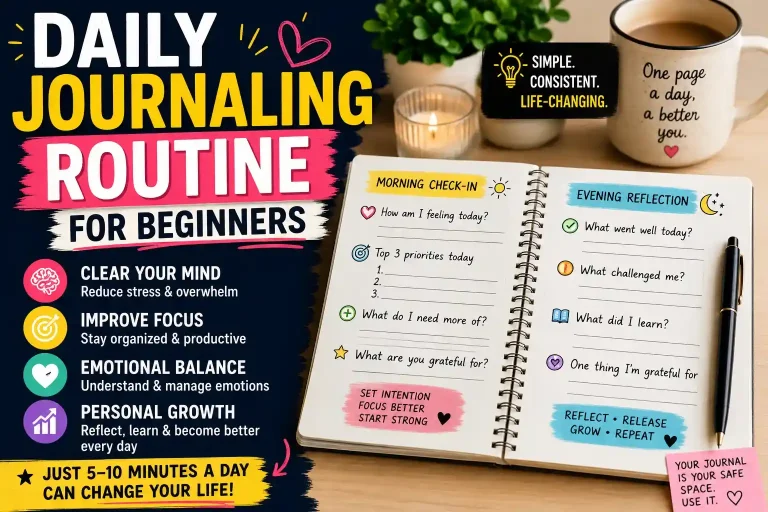
How to Start Journaling for Beginners: A Simple Guide to Clarity, Focus, and Better Daily Living

Modern life is noisy.
Most people wake up already overwhelmed by:
- notifications
- unfinished tasks
- mental clutter
- stress
- overthinking
- constant distractions
The mind rarely gets a chance to slow down.
That is one of the biggest reasons journaling has become so powerful in recent years.
Journaling is not just about writing random thoughts into a notebook. It is a practical tool that helps people:
- organize their mind
- improve focus
- reduce stress
- process emotions
- build better habits
- understand themselves more clearly
The best part?
You do not need to be a writer, creative expert, or productivity guru to start.
Anyone can journal.
This guide will show you exactly how to start journaling for beginners in a simple, realistic, and sustainable way.
How to Start Journaling for Beginners
Journaling helps clear mental clutter, improve focus, reduce stress, and organize your thoughts more effectively.
Whether you want better productivity, emotional clarity, or mindful daily routines, starting a simple journaling habit can transform your life gradually over time.
What Is Journaling?
Journaling is the practice of writing down thoughts, experiences, emotions, ideas, goals, or reflections in a structured or unstructured format.
Some people journal to:
- clear their mind
- manage anxiety
- improve productivity
- track habits
- organize daily life
- increase self-awareness
- reflect on emotions
Others simply use journaling as a quiet mental reset.
There is no single “perfect” journaling method.
The goal is not perfection.
The goal is awareness and clarity.
Why Journaling Is So Powerful
Most people carry too many thoughts mentally.
Unfinished ideas, stress, worries, reminders, and emotions continuously compete for attention.
This creates:
- mental overload
- distraction
- emotional exhaustion
- poor focus
- anxiety
Writing things down changes that.
Journaling helps move thoughts out of the mind and onto paper.
This creates mental space.
Instead of your brain trying to remember and organize everything at once, journaling allows you to:
- slow down
- process information clearly
- organize priorities
- think intentionally
Many people are surprised how much calmer they feel after even 10 minutes of writing.
Benefits of Journaling for Beginners
Journaling offers both mental and practical benefits.
Improved Mental Clarity
Writing helps organize scattered thinking.
When thoughts become visible on paper, confusion often becomes easier to understand.
Reduced Stress and Anxiety
Journaling helps release emotional pressure.
Instead of carrying stress internally, writing creates a healthy outlet.
Better Focus
A cluttered mind struggles to focus.
Journaling helps identify priorities and reduce mental distractions.
Increased Self-Awareness
Many people go through life reacting automatically without understanding their patterns.
Journaling helps people notice:
- emotions
- habits
- triggers
- behaviors
- recurring thoughts
This improves self-awareness over time.
Stronger Decision-Making
Writing slows reactive thinking.
When thoughts are written down, decisions often become clearer and more intentional.
Better Habit Building
Tracking behaviors and routines inside a journal improves consistency.
This is why journaling is commonly used for:
- fitness goals
- productivity systems
- mental wellness
- habit tracking
- personal growth
Do You Need a Fancy Journal?
No.
One of the biggest beginner mistakes is overcomplicating journaling before even starting.
You do not need:
- expensive notebooks
- perfect handwriting
- aesthetic layouts
- complicated systems
You only need:
- something to write on
- consistency
- honesty
A simple notebook works perfectly.
Some people prefer:
- digital journaling apps
- note-taking tools
- minimalist planners
- tablets
Choose whatever feels easiest and most sustainable.
The best journal is the one you actually use.
How to Start Journaling for Beginners
Starting is often the hardest part.
Most beginners overthink the process because they assume they need to write something deep or impressive.
You do not.
Start simple.
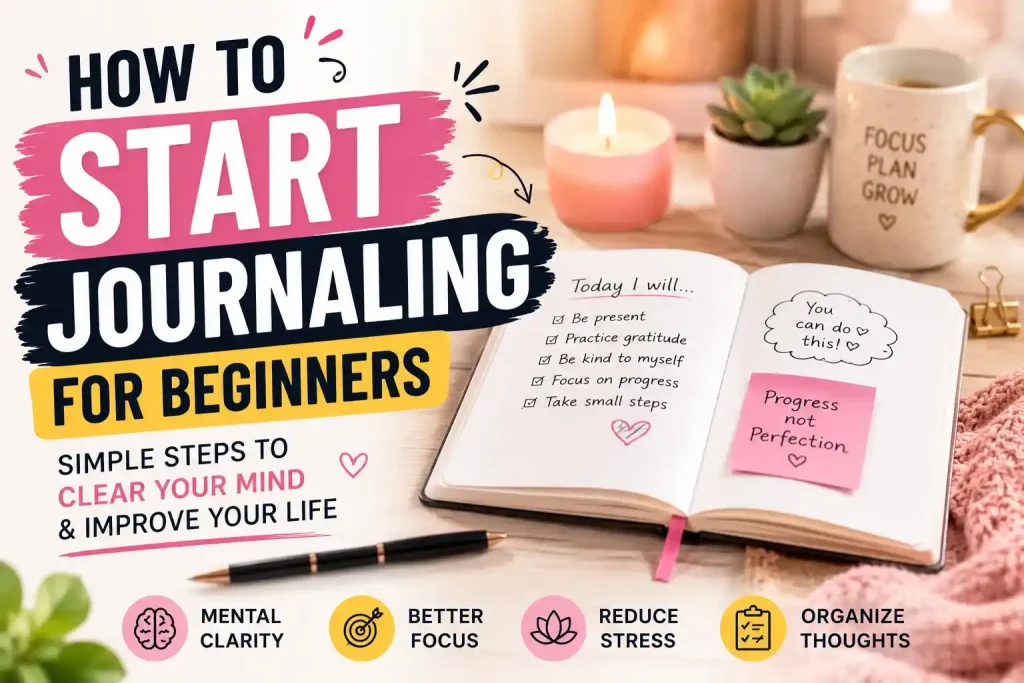
Step 1: Choose Your Journaling Purpose
Before writing, ask yourself:
Why do I want to journal?
Your answer helps shape your journaling style.
Common reasons include:
- stress relief
- emotional processing
- productivity
- daily planning
- self-improvement
- mindfulness
- habit tracking
- reflection
Your journal does not need one perfect purpose forever.
It can evolve over time.
Step 2: Keep It Simple
Do not try to create a perfect system immediately.
Many beginners quit because they:
- overdesign pages
- create unrealistic routines
- expect instant transformation
Instead:
- write naturally
- keep entries short initially
- focus on consistency
Even writing 5 minutes daily is valuable.
Step 3: Create a Small Daily Routine
Consistency matters more than intensity.
Choose a realistic time.
Popular journaling times include:
- morning journaling
- nighttime reflection
- lunch break resets
- post-work decompression
Start with:
- 5–10 minutes daily
That is enough.
A small sustainable habit is far more powerful than an overwhelming system you abandon after three days.
Step 4: Write Without Judging Yourself
Your journal is not a performance.
It does not need to sound intelligent, motivational, or perfect.
Write honestly.
Messy writing is still useful writing.
Many beginners struggle because they try to:
- sound profound
- write perfectly
- impress themselves
Forget that.
The goal is clarity, not perfection.
Step 5: Use Simple Prompts
If you do not know what to write, prompts help tremendously.
Beginner journaling prompts include:
- What is currently on my mind?
- What stressed me today?
- What am I grateful for?
- What distracted me recently?
- What do I need to focus on?
- What made me feel calm today?
- What is one thing I want to improve?
- What drained my energy today?
- What matters most right now?
- What am I avoiding?
Simple questions often create surprisingly deep insights.
Best Types of Journaling for Beginners
There are many journaling styles.
You do not need to master all of them.
Experiment and find what feels natural.
Daily Reflection Journaling
This is one of the easiest forms.
Simply reflect on:
- your day
- emotions
- experiences
- lessons
- thoughts
It helps improve awareness and emotional clarity.
Gratitude Journaling
Gratitude journaling focuses attention on positive experiences.
Examples:
- something meaningful today
- someone you appreciate
- small moments of peace
- personal progress
This helps reduce constant negative mental focus.
Brain Dump Journaling
This method involves writing every thought freely without structure.
It is especially useful during:
- stress
- overthinking
- mental overload
- anxiety
The purpose is mental release.
Not organization.
Bullet Journaling
Bullet Journaling combines:
- planning
- tracking
- productivity
- organization
- reflection
It often includes:
- daily logs
- habit trackers
- task lists
- calendars
- goal pages
Beginners should keep Bullet Journaling minimal initially.
Do not compare yourself to highly artistic social media setups.
Goal Journaling
This style focuses on:
- goals
- habits
- growth
- progress tracking
It helps create intentional direction.
Mental Health Journaling
Many people use journaling to:
- process emotions
- manage stress
- identify triggers
- improve mindfulness
Writing creates emotional awareness that is often difficult to achieve mentally alone.
Morning Journaling vs Night Journaling
Both approaches offer different benefits.
Morning Journaling
Morning journaling helps:
- clear mental clutter
- improve focus
- organize priorities
- start the day intentionally
It is excellent for:
- planning
- focus
- mindset preparation
Night Journaling
Night journaling helps:
- reflect on the day
- process emotions
- reduce mental noise
- decompress before sleep
It works especially well for emotional reflection.
Common Beginner Journaling Mistakes
Many people accidentally make journaling stressful.
Avoid these common mistakes.
Trying to Be Perfect
Your journal does not need:
- beautiful handwriting
- perfect grammar
- deep wisdom
Honesty matters more.
Writing Too Much Initially
Starting with huge expectations often causes burnout.
Keep entries manageable.
Consistency matters more than length.
Comparing Yourself to Social Media Journals
Many online journaling pages focus heavily on aesthetics.
That is not necessary.
A useful journal is more valuable than a visually perfect one.
Expecting Instant Results
Journaling creates gradual improvement.
Benefits build through:
- consistency
- reflection
- awareness
- repetition
Do not expect life-changing transformation after one entry.
Turning Journaling Into Another Stressful Task
Your journal should help reduce pressure.
If your system feels overwhelming, simplify it.
How Journaling Improves Mental Clarity
One of the biggest reasons people continue journaling long term is mental clarity.
The brain constantly processes:
- information
- emotions
- reminders
- stress
- distractions
Without external organization, thoughts become mentally exhausting.
Journaling helps separate:
- important thoughts
- emotional reactions
- priorities
- unnecessary mental noise
This creates calmer thinking.
Many people notice:
- improved focus
- reduced overthinking
- clearer priorities
- better emotional awareness
within weeks of consistent journaling.
Journaling and Productivity
Journaling is not only emotional.
It is also highly practical.
Writing helps improve:
- planning
- organization
- focus
- intentional action
Many productivity systems actually rely on journaling principles.
Examples include:
- task tracking
- daily planning
- habit monitoring
- weekly reflection
- goal review
The key difference is that journaling combines productivity with awareness.
Instead of blindly completing tasks, journaling encourages intentional action.
How to Stay Consistent With Journaling
Consistency is one of the hardest parts for beginners.
These strategies help.
Make Journaling Easy
Remove friction.
Keep your journal visible.
Avoid complicated setups.
Attach Journaling to Existing Habits
Pair journaling with routines you already do.
Examples:
- after coffee
- before bed
- after work
- after meditation
This helps journaling become automatic.
Start Small
Even:
- one paragraph
- three sentences
- five minutes
is enough.
Small habits create long-term consistency.
Accept Imperfection
Missing days is normal.
Do not quit because of inconsistency.
Simply continue.
Should You Journal Digitally or on Paper?
Both approaches work.
Choose based on preference.
Paper Journaling
Benefits include:
- deeper focus
- fewer distractions
- physical connection to writing
- slower intentional thinking
Many people find handwriting calming.
Digital Journaling
Benefits include:
- convenience
- speed
- organization
- portability
Digital journaling works especially well for busy schedules.
The best option is whichever you will realistically maintain.
Journaling for Overthinkers
Overthinking often happens because thoughts continuously loop mentally.
Journaling interrupts that cycle.
Writing helps externalize thoughts instead of endlessly replaying them internally.
This creates:
- perspective
- emotional distance
- clarity
- calmer thinking
Many overthinkers discover journaling becomes one of their most effective mental tools.
How Long Does Journaling Take to Help?
Some people feel immediate relief after writing.
Long-term benefits usually appear through:
- consistent reflection
- emotional awareness
- repeated mental organization
Within several weeks, many people notice:
- reduced mental clutter
- better emotional regulation
- stronger focus
- increased self-awareness
Journaling is less about instant transformation and more about gradual mental improvement.
Building Your Own Journaling System
Eventually, your journal becomes personal.
You may combine:
- reflection
- planning
- productivity
- gratitude
- goal tracking
- emotional processing
There is no universal perfect structure.
The most effective journal is one designed around:
- your life
- your needs
- your personality
- your goals
Flexibility is important.
Why Journaling Still Matters in a Digital World
Modern technology increases:
- distraction
- speed
- information overload
Journaling slows thinking down intentionally.
That makes it increasingly valuable.
Writing helps people reconnect with:
- focus
- awareness
- intentional living
- emotional clarity
In a world constantly demanding attention, journaling creates rare mental quiet.
Final Thoughts
Learning how to start journaling for beginners does not require perfection, creativity, or complicated systems.
It simply requires honesty, consistency, and willingness to slow down.
Journaling helps people:
- organize thoughts
- reduce stress
- improve focus
- understand emotions
- build better habits
- create mental clarity
You do not need to write pages every day.
You only need a place to begin.
Start small.
Write honestly.
Reflect consistently.
Over time, journaling becomes more than a habit.
It becomes a powerful system for:
- self-awareness
- mental clarity
- intentional living
- calmer daily life
Sometimes the simplest tool for changing your life is simply writing your thoughts down one page at a time.