
Are Monthly Contacts Good for 30 Days?
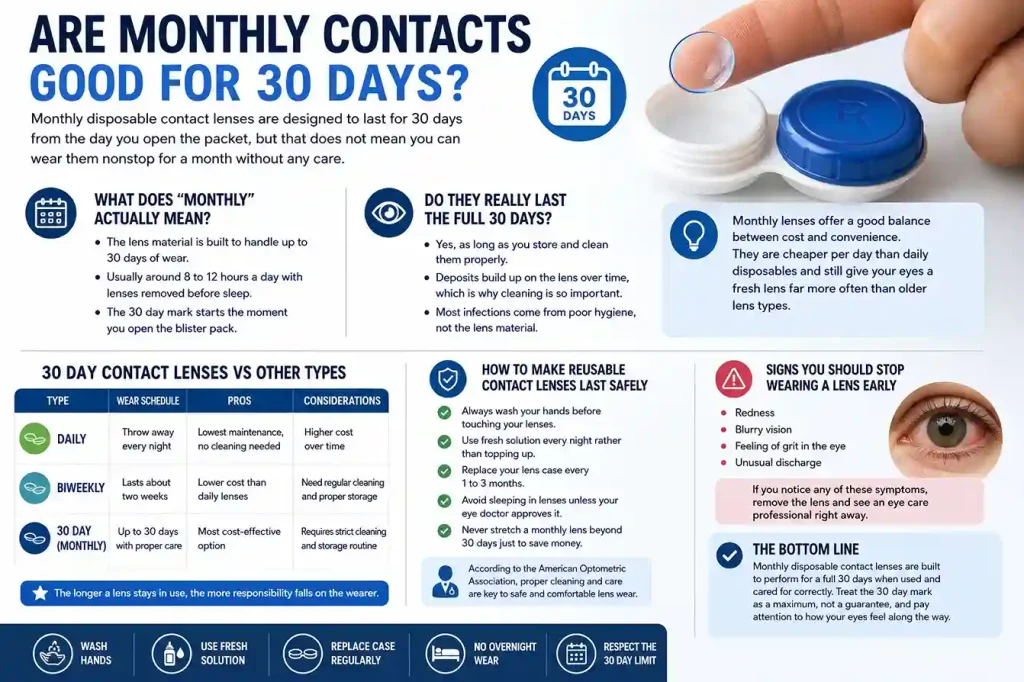
Monthly disposable contact lenses are designed to last for 30 days from the day you open the packet, but that does not mean you can wear them nonstop for a month without any care. How long they actually stay safe and comfortable depends on how you wear them, how you clean them, and how well you look after your eyes during that time.
What Does “Monthly” Actually Mean?
When a lens is labeled monthly, it means the lens material is built to handle up to 30 days of wear, usually around 8 to 12 hours a day with the lenses removed before sleep. This is different from sleeping in them every night, since most lenses are not approved for extended overnight wear unless stated otherwise. The 30 day mark starts ticking the moment you open the blister pack, not the first time you put the lens in your eye.
Monthly disposable contact lenses are popular because they offer a good balance between cost and convenience. You get a full month of wear from one pair, which works out cheaper per day than daily disposables, while still giving your eyes a fresh lens far more often than older lens types from years ago.
Do They Really Last the Full 30 Days?
In most cases, yes, as long as you store and clean them properly. According to information shared by the American Optometric Association, protein and lipid deposits build up on a lens surface over time, which is why cleaning routines matter so much for reusable contact lenses. A lens that looks fine on day 25 might already be holding onto bacteria or debris that you cannot see with the naked eye.
Studies on lens wearers have shown that a large number of eye infections linked to contact lenses are tied to poor hygiene rather than the lens material itself. This includes things like topping up old solution instead of replacing it fully, wearing lenses for longer than recommended, or skipping the case cleaning step. So the 30 day claim on the box is accurate for the lens material, but the real life safety window depends heavily on the wearer’s habits.
30 Day Contact Lenses vs Other Types
There are three main wear schedules on the market: daily, biweekly, and 30 day contact lenses. Daily lenses get thrown away every night, biweekly lenses last about two weeks, and monthly lenses stretch the furthest. The trade off is that the longer a lens stays in use, the more responsibility falls on the wearer to clean it correctly each night.
Monthly lenses tend to suit people who want lower running costs and don’t mind the extra step of cleaning and storing their lenses every evening. Daily lenses suit people who want the lowest maintenance and don’t want to think about solutions or cases at all.
How to Make Reusable Contact Lenses Last Safely
A few habits make a real difference in whether your lenses stay comfortable and safe for the full month:
Always wash your hands before touching your lenses. Use fresh solution every night rather than topping up the same liquid. Replace your lens case every one to three months, since cases can build up their own layer of bacteria over time. Avoid sleeping in lenses unless your eye doctor has specifically approved that for your prescription. Never stretch a monthly lens beyond 30 days just to save money, since the material does break down with wear even if it looks fine.
Signs You Should Stop Wearing a Lens Early
Even within the 30 day window, some lenses need to come out sooner. Redness, blurry vision, a feeling of grit in the eye, or unusual discharge are all signs that something is wrong, and continuing to wear the lens can make things worse. If any of these symptoms show up, it is worth removing the lens and getting checked by an eye care professional rather than waiting out the rest of the month.
The Bottom Line
Monthly disposable contact lenses are built to perform for a full 30 days when used and cared for correctly. The lens material itself is designed for that lifespan, but the real deciding factor is how consistently you clean, store, and handle them each day. Treat the 30 day mark as a maximum, not a guarantee, and pay attention to how your eyes feel along the way.