Hearthstats Net News: The Complete Guide to Hearthstone Analytics, History, Modern Alternatives & Competitive Gaming (2026)
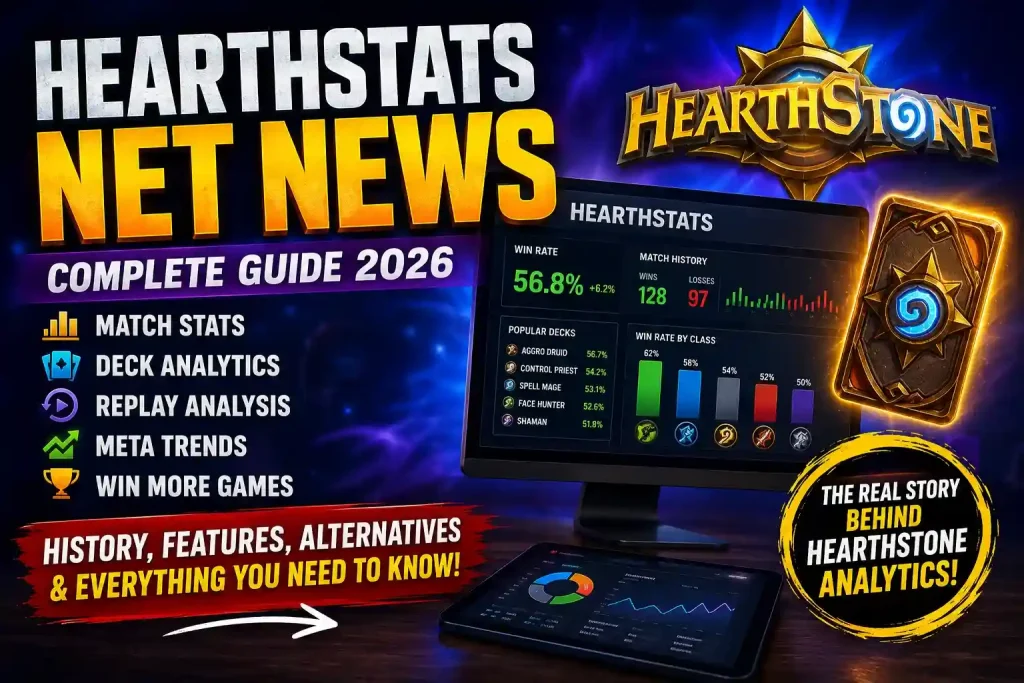
If you’ve searched for Hearthstats Net News, you’re probably trying to understand what happened to one of the most recognized Hearthstone analytics platforms. Many longtime players remember Hearthstats as an essential companion for tracking matches, analyzing decks, and improving gameplay.
Before sophisticated tracking software became widely available, Hearthstats gave players something revolutionary: detailed match statistics, deck performance reports, replay analysis, and valuable insights that were unavailable inside the game itself.
Although newer analytics platforms have largely replaced it, Hearthstats remains an important part of Hearthstone’s history. Its influence can still be seen in today’s deck trackers, live overlays, replay systems, and data-driven strategy tools used by competitive players worldwide.
In this complete guide, you’ll learn what Hearthstats Net News is, why it became so popular, how it changed competitive Hearthstone, which alternatives are best in 2026, and whether it still has any relevance today.
What Is Hearthstats Net News?
Hearthstats Net News refers to articles, updates, discussions, and historical information surrounding the former Hearthstats platform one of the earliest and most influential analytics websites created for Hearthstone players.
When Hearthstone first launched, players had very limited access to performance statistics. The game only displayed basic information such as wins and losses, making it difficult to understand why certain decks performed well while others struggled.
Hearthstats solved this problem by collecting match data and transforming it into meaningful analytics. Instead of relying on memory, players could review hundreds of games, identify winning patterns, analyze unfavorable matchups, and improve their deck-building decisions.
For competitive players, this was a major breakthrough. It introduced a data-driven approach to strategy long before advanced tracking software became common.
Why Hearthstats Became So Popular
Timing played a huge role in Hearthstats’ success.
During the early years of Hearthstone, the competitive scene was growing rapidly. Ranked ladder became more competitive, Twitch streamers attracted millions of viewers, and professional tournaments gained worldwide attention.
Players wanted answers to questions like:
- Which deck has the highest win rate?
- Which hero performs best after a balance patch?
- Which cards should I replace?
- Why am I losing against specific classes?
- Which strategies are dominating the current meta?
At that time, Blizzard did not provide detailed in-game analytics.
Hearthstats filled this gap by giving players access to information that helped them make smarter decisions. Instead of guessing, users could rely on real match statistics collected from thousands of games.
This made the platform incredibly valuable for both casual and competitive players.
Why Analytics Changed Hearthstone Forever
Competitive games reward informed decisions.
Before analytics tools became popular, most players relied on personal experience or opinions shared in forums. While useful, these methods were often unreliable and influenced by small sample sizes.
Analytics completely changed that.
Instead of saying, “This deck feels strong,” players could say, “This deck has a 61% win rate across 50,000 matches.”
That shift transformed how players approached the game.
Statistics began influencing:
- Deck building
- Card selection
- Mulligan decisions
- Matchup preparation
- Tournament strategies
- Meta predictions
Professional players increasingly trusted measurable data, while casual players gained insights that helped them improve much faster.
History of Hearthstats
Hearthstats was introduced during the early years of Hearthstone, when the game was rapidly becoming one of the most popular digital collectible card games in the world. Competitive players wanted more than just a record of wins and losses. They wanted detailed insights into their gameplay, deck performance, and matchup statistics.
At the time, Hearthstone itself offered only basic information. Players had no simple way to track how specific decks performed against different classes or how balance updates affected their success. Hearthstats filled that gap by providing a centralized platform where players could record matches, analyze results, and refine their strategies.
As the competitive community grew, so did the platform. Thousands of players began using Hearthstats to monitor their progress, experiment with new deck builds, and stay ahead of the evolving meta. For many, it became an essential companion rather than just another gaming website.
Although newer tools eventually replaced it, Hearthstats remains an important milestone in the history of Hearthstone analytics. Many of the features players now consider standard were first introduced or popularized by platforms like Hearthstats.
Hearthstats Timeline
Understanding the platform’s history helps explain why people still search for Hearthstats Net News today.
| Year | Major Milestone |
|---|---|
| 2014 | Hearthstats gains popularity among early Hearthstone players |
| 2015 | Thousands of users begin tracking ranked matches and deck performance |
| 2016 | Competitive tournaments increase demand for advanced analytics |
| 2017 | New tracking platforms begin entering the market |
| 2018 | Modern analytics tools offer deeper integrations and live tracking |
| 2019–2022 | Players gradually migrate to newer platforms like HSReplay and Firestone |
| 2023–2026 | Hearthstats remains an important part of Hearthstone history and is still widely searched |
The timeline shows how quickly analytics evolved. What once felt revolutionary eventually became the standard for competitive gaming.
How Hearthstats Changed Competitive Hearthstone
Before analytics platforms became common, improvement depended mostly on memory and personal experience.
A player might believe they performed well with a particular deck simply because they remembered a few exciting victories. In reality, their overall win rate could be much lower than expected.
Hearthstats introduced objective measurement.
Instead of relying on assumptions, players could review real performance data collected across dozens or even hundreds of matches. This allowed them to identify weaknesses that were almost impossible to notice through memory alone.
For example, a player might discover that:
- Their Control Warrior deck performs well against Hunters but struggles against Mages.
- A recent deck change reduced their overall win rate.
- They consistently lose when going second.
- One specific card rarely provides value during ranked matches.
These insights helped players make informed decisions rather than emotional ones.
As analytics became more popular, competitive Hearthstone shifted from instinct-based play toward data-driven strategy.
Core Features That Made Hearthstats Stand Out
Many gaming websites reported news, but Hearthstats focused on helping players become better competitors.
Several features made the platform stand out from ordinary gaming blogs.
Match Tracking
Every recorded game added valuable information to a player’s statistics.
Users could monitor:
- Wins and losses
- Opponent classes
- Deck performance
- Ranked progression
- Overall consistency
Instead of guessing how well a deck performed, players had measurable evidence.
Deck Performance Reports
One of Hearthstats’ biggest strengths was its ability to evaluate entire decks over long periods.
Rather than judging a deck after only a few matches, players could analyze performance across hundreds of games.
This made it easier to identify:
- Reliable decks
- Weak matchups
- Cards that underperformed
- Long-term trends
Small improvements often translated into higher win rates over time.
Replay Analysis
Watching previous matches became one of the fastest ways to improve.
Replay analysis allowed players to review important decisions instead of relying on memory.
Many users discovered mistakes they had completely overlooked during live gameplay, such as:
- Incorrect mulligan choices
- Poor resource management
- Missed lethal opportunities
- Inefficient trading
- Risky late-game decisions
Learning from previous matches helped players improve much faster than simply playing more games.
Meta Analysis
Hearthstone changes constantly.
Every expansion and balance patch creates new deck archetypes while weakening others.
Hearthstats collected large amounts of gameplay data to identify these changes early.
Players could see:
- Popular decks
- Rising archetypes
- Declining strategies
- Win-rate trends
- Class popularity
This information gave competitive players a significant advantage when preparing for ranked play or tournaments.
Why Players Trusted Statistics Over Opinions
Competitive communities often generate thousands of opinions after every expansion.
Some players claim a new deck is unbeatable.
Others insist it is weak.
Without data, these debates rarely lead to useful conclusions.
Hearthstats replaced speculation with evidence.
Instead of asking which deck “felt” strongest, players could compare actual win rates collected from real matches.
That shift changed how the community approached strategy.
Statistics became an important part of discussions surrounding balance updates, tournament preparation, and deck optimization.
Many professional players began combining personal experience with analytical data, creating a more balanced approach to competitive play.
How Hearthstats Helped Casual Players
Analytics were not only useful for tournament competitors.
Casual players also benefited in several ways.
Tracking personal progress created motivation.
Watching win rates improve over time gave players confidence that their practice was paying off.
The platform also encouraged experimentation.
Instead of abandoning a deck after a few losses, players could evaluate its long-term performance before making changes.
For newer players, Hearthstats acted as a learning tool that explained patterns they might otherwise miss.
It transformed raw gameplay into valuable lessons, making improvement feel more achievable and rewarding.
Understanding Deck Analytics
One of Hearthstats’ biggest innovations was deck analytics. Instead of simply recording wins and losses, the platform analyzed how an entire deck performed over time. This gave players a much clearer picture of what was actually working and what needed improvement.
For example, imagine you have played 300 ranked matches with the same deck. At first glance, you might think the deck is performing well because you remember several exciting wins. However, the statistics may reveal a different story.
You might discover that:
- The deck wins consistently against Hunter and Paladin.
- It struggles against Mage and Priest.
- Your overall win rate drops significantly after replacing one key card.
- The deck performs much better when going first.
Without analytics, these patterns are difficult to notice. Hearthstats transformed hundreds of individual games into meaningful information that players could use to improve their results.
How Win Rates Are Calculated
Many players see a win-rate percentage without understanding what it actually represents.
A win rate is calculated by dividing the number of victories by the total number of matches played.
For example:
| Matches Played | Wins | Losses | Win Rate |
|---|---|---|---|
| 100 | 58 | 42 | 58% |
| 250 | 150 | 100 | 60% |
| 500 | 315 | 185 | 63% |
While a 100% win rate may look impressive after only five games, experienced players know that larger sample sizes provide much more reliable information.
This is why Hearthstats encouraged long-term tracking rather than judging a deck after only a few matches.
How Match Tracking Actually Worked
Every match generated valuable information.
Instead of simply recording whether you won or lost, Hearthstats collected additional details that helped players understand their performance.
Typical match data included:
- Opponent class
- Your deck
- Match result
- Game mode
- Date and time
- Rank
- Match duration
Over time, this information created a detailed history of a player’s progress.
Rather than relying on memory, users could identify trends that developed over weeks or even months of gameplay.
Why Matchup Statistics Matter
Winning against one class does not guarantee success against another.
A deck that performs extremely well against aggressive strategies may struggle against slower control decks.
Matchup statistics allow players to identify these strengths and weaknesses before entering ranked matches.
For example:
| Opponent Class | Matches | Wins | Win Rate |
|---|---|---|---|
| Hunter | 60 | 42 | 70% |
| Mage | 55 | 24 | 44% |
| Warrior | 48 | 30 | 63% |
| Priest | 40 | 18 | 45% |
After reviewing these numbers, players can adjust their decks to improve weaker matchups instead of making random changes.
The Science Behind Meta Reports
The Hearthstone meta changes constantly.
Every balance update, expansion, and mini-set introduces new cards that influence which decks become popular.
Meta reports analyze large collections of match data to determine which strategies currently perform best.
Instead of focusing on a single player’s experience, these reports combine thousands—or even millions—of matches to identify broader trends.
A typical meta report includes:
- Most popular decks
- Highest win-rate decks
- Fastest climbing strategies
- Class popularity
- Performance by rank
- Recent balance changes
Competitive players often review these reports before building a new deck or entering tournaments.
Why Meta Reports Help Competitive Players
Imagine entering ranked play without knowing the current meta.
You might spend hours using a deck that performs poorly against today’s most popular strategies.
Meta reports reduce that uncertainty.
For example, if reports show that Aggro Paladin is dominating the ladder, players can prepare by choosing decks with strong defensive tools or favorable matchups.
This proactive approach often leads to better long-term results than reacting after multiple losses.
Common Mistakes Players Make When Using Analytics
Analytics are powerful, but they can also be misunderstood.
Here are some of the most common mistakes.
Focusing on Small Sample Sizes
Winning five games in a row does not necessarily mean a deck is excellent.
Reliable conclusions require a much larger number of matches.
Ignoring Skill Differences
Statistics cannot account for every factor.
A highly experienced player may achieve much better results with the same deck than a beginner.
Always consider personal skill alongside raw numbers.
Blindly Copying Popular Decks
Many players assume that the highest win-rate deck will automatically improve their ranking.
In reality, success also depends on familiarity, decision-making, and playstyle.
Choosing a deck that matches your strengths often produces better results than simply copying the current meta.
Ignoring Recent Balance Changes
Statistics collected before a major patch may no longer reflect the current game.
Always use recent data when evaluating deck performance.
Why Hearthstats Eventually Declined
Although Hearthstats played a major role in Hearthstone’s early years, technology continued to evolve.
New analytics platforms introduced features that were difficult for older systems to match.
These improvements included:
- Automatic match detection
- Real-time overlays
- Live deck tracking
- AI-powered recommendations
- Faster data collection
- More detailed statistics
- Cloud synchronization
As these features became standard, many players gradually migrated to newer platforms offering more advanced functionality.
This transition did not erase Hearthstats’ legacy—it simply reflected the rapid pace of innovation within competitive gaming.
What Replaced Hearthstats?
Several platforms eventually became the preferred choice for Hearthstone players.
HSReplay
HSReplay is now considered one of the most comprehensive Hearthstone analytics platforms.
It offers:
- Massive match database
- Live meta reports
- Deck win rates
- Replay analysis
- Rank-based statistics
- Premium advanced analytics
Its extensive data collection makes it one of the most trusted resources for competitive players.
Firestone
Firestone focuses on delivering a modern user experience.
Key features include:
- Live in-game overlays
- Automatic tracking
- Collection management
- Match history
- Achievement tracking
- Performance summaries
Its clean interface has made it especially popular among casual and competitive players alike.
Hearthstone Deck Tracker
One of the oldest and most respected tracking tools, Hearthstone Deck Tracker remains a favorite for players who want detailed in-game information.
It provides:
- Remaining deck cards
- Opponent card tracking
- Match history
- Performance analysis
- Collection statistics
For many players, it has become an essential part of competitive play.
Hearthstats vs HSReplay
Although Hearthstats helped pioneer Hearthstone analytics, today’s players have access to far more advanced tools. The biggest name in modern analytics is HSReplay, a platform that processes millions of games to provide detailed insights into the current meta.
Here’s how the two platforms compare.
| Feature | Hearthstats | HSReplay |
|---|---|---|
| Match Tracking | Yes | Yes |
| Replay Analysis | Yes | Yes |
| Live Meta Reports | Limited | Excellent |
| Automatic Deck Tracking | Basic | Advanced |
| Rank-Based Statistics | Limited | Yes |
| Mobile Support | Limited | Better |
| AI Insights | No | Partial |
| Active Development | No | Yes |
| Best For | Historical Analytics | Competitive Players |
For players focused on climbing the ranked ladder, HSReplay provides more comprehensive and up-to-date information. However, Hearthstats deserves recognition for laying the foundation that inspired many of today’s analytics platforms.
Hearthstats vs Firestone
Firestone takes a different approach by emphasizing user experience alongside powerful analytics.
| Feature | Hearthstats | Firestone |
|---|---|---|
| User Interface | Simple | Modern |
| Live Overlay | No | Yes |
| Match Tracking | Yes | Yes |
| Collection Tracking | Limited | Excellent |
| Achievement Tracking | No | Yes |
| Deck Suggestions | Basic | Advanced |
| Automatic Updates | Limited | Yes |
| Beginner Friendly | Yes | Excellent |
Firestone is particularly popular among players who want real-time information without constantly switching between different applications.
Which Analytics Tool Should You Choose?
The best platform depends on your goals.
Choose HSReplay If You Want
- Detailed meta reports
- Professional-level statistics
- Deck performance across different ranks
- Large match databases
- Competitive ladder improvement
Choose Firestone If You Want
- Beautiful interface
- Live overlays
- Automatic tracking
- Collection management
- Easy-to-read reports
Choose Hearthstone Deck Tracker If You Want
- Reliable in-game tracking
- Remaining deck cards
- Opponent card tracking
- Lightweight performance
- Simple gameplay assistance
Can Hearthstats Still Improve Your Gameplay?
Although Hearthstats itself is no longer the primary analytics platform, the principles it introduced remain incredibly valuable.
Players who regularly review their performance tend to improve faster because they:
- Recognize recurring mistakes
- Understand difficult matchups
- Identify weak deck choices
- Learn from previous games
- Make decisions based on evidence rather than emotion
Analytics alone will not make someone a professional player, but they provide a roadmap for consistent improvement.
Is Hearthstats Still Relevant in 2026?
The original platform is no longer the industry leader, but its historical importance remains undeniable.
Many modern analytics features that players now take for granted first became popular through early platforms like Hearthstats.
Today, its relevance comes from three key areas.
Historical Importance
Hearthstats helped introduce millions of players to the concept of data-driven gameplay.
Educational Value
New players researching Hearthstone analytics often discover Hearthstats while learning how competitive tracking evolved.
Gaming Legacy
The platform played an important role in shaping modern deck tracking, replay analysis, and statistical performance tools.
Even though newer software has surpassed it technically, Hearthstats remains an important chapter in Hearthstone history.
Is Hearthstats Safe?
Many users searching for Hearthstats Net News also wonder whether the platform is safe.
If you are exploring older gaming websites, keep these best practices in mind.
Check Official Sources
Whenever possible, visit official websites or trusted gaming communities for current information.
Avoid Unofficial Downloads
Never install unknown software from unofficial download pages.
Use trusted sources whenever downloading deck trackers or analytics applications.
Keep Software Updated
Modern analytics tools frequently release security updates and bug fixes.
Keeping applications updated helps reduce potential security risks.
Protect Your Blizzard Account
Never share your Battle.net login credentials with unofficial websites or third-party services.
Account security should always come first.
Pros and Cons of Hearthstats
Like any platform, Hearthstats had strengths and limitations.
Pros
- One of the earliest Hearthstone analytics platforms
- Easy-to-understand statistics
- Useful replay analysis
- Helped players improve through data
- Built a strong competitive community
- Influenced modern tracking software
Cons
- No longer actively leading the market
- Limited compared with modern analytics tools
- Fewer automation features
- Smaller databases than current competitors
- Outdated interface by today’s standards
Despite these limitations, its influence on competitive Hearthstone remains significant.
Why Players Still Search for Hearthstats Net News
Years after its peak, thousands of players continue searching for Hearthstats-related topics.
Some are longtime players revisiting old memories.
Others are new players researching the history of Hearthstone analytics.
Common search reasons include:
- Learning about classic tracking tools
- Finding Hearthstats alternatives
- Understanding competitive analytics
- Comparing old and modern platforms
- Researching Hearthstone history
This continued interest demonstrates the platform’s lasting reputation within the gaming community.
Expert Tips for Using Hearthstone Analytics
Professional players rarely depend on statistics alone.
Instead, they combine analytics with practical experience.
Here are a few best practices.
- Review your match history every few days.
- Focus on improving one matchup at a time.
- Avoid changing your deck after every loss.
- Study replay mistakes instead of blaming bad luck.
- Use recent statistics after every balance patch.
- Compare multiple analytics platforms before drawing conclusions.
- Build decks that match your personal playstyle rather than simply copying popular lists.
Consistent improvement comes from combining good data with thoughtful decision-making.
The Future of Hearthstone Analytics
The world of competitive gaming continues to evolve, and Hearthstone analytics are evolving with it. What started as simple win-loss tracking has transformed into sophisticated platforms capable of analyzing millions of games in real time.
Today’s players expect much more than basic statistics. They want instant insights, personalized recommendations, live overlays, replay analysis, and accurate predictions based on current meta trends.
As technology advances, analytics platforms will become even smarter, giving players deeper insights while making competitive improvement more accessible than ever before.
Artificial Intelligence Is Changing Analytics
Artificial Intelligence (AI) is beginning to play a much larger role in competitive gaming.
Instead of simply displaying historical data, AI-powered systems can identify hidden patterns that would be difficult for humans to notice.
Future analytics platforms may help players by:
- Suggesting better mulligan choices
- Identifying recurring gameplay mistakes
- Recommending stronger deck changes
- Predicting difficult matchups
- Highlighting missed lethal opportunities
- Analyzing decision-making patterns
Rather than replacing player skill, AI is becoming a coaching tool that helps players learn more efficiently.
Real-Time Match Analysis
One of the biggest developments in gaming analytics is real-time analysis.
Modern tools can already provide live information while a match is being played.
Examples include:
- Remaining cards in your deck
- Opponent card predictions
- Win probability estimates
- Mana curve analysis
- Matchup statistics
- Performance summaries
These features help players make more informed decisions without changing the core gameplay experience.
Cloud-Based Analytics Continue to Grow
Unlike older tracking tools that stored information only on one computer, modern analytics platforms increasingly rely on cloud technology.
Cloud-based systems allow players to:
- Access statistics from multiple devices
- Synchronize match history automatically
- Store replay data securely
- Compare results over long periods
- Receive updates instantly
This flexibility has become especially important for players who compete on different computers or frequently travel.
Why Analytics Will Always Matter
Some players believe statistics reduce creativity.
Others believe analytics improve competitive fairness.
The reality lies somewhere between these views.
Statistics cannot replace experience, but they help players understand their own performance more clearly.
The strongest competitors combine:
- Practical experience
- Personal playstyle
- Match history
- Meta knowledge
- Reliable analytics
This balanced approach consistently produces better long-term results than relying on instinct alone.
Frequently Asked Questions
What is Hearthstats Net News?
Hearthstats Net News refers to articles, discussions, updates, and historical information related to Hearthstats, one of the earliest analytics platforms created for Hearthstone players.
Is Hearthstats still active?
The original platform no longer plays the same role it once did. Modern alternatives now provide more advanced features, but Hearthstats remains an important part of Hearthstone’s history.
Why was Hearthstats so popular?
It became popular because it gave players access to detailed match tracking, replay analysis, deck statistics, and performance reports long before these features became common.
What replaced Hearthstats?
everal platforms eventually became industry leaders, including:
HSReplay
Firestone
Hearthstone Deck Tracker
These tools provide more advanced analytics and real-tim Se tracking.
Can analytics improve my win rate?
Yes
While analytics cannot replace skill, they help players identify mistakes, improve deck choices, understand difficult matchups, and make more informed strategic decisions.
Are third-party Hearthstone trackers allowed?
Most well-known tracking tools are generally accepted as long as they comply with Blizzard’s policies and do not provide unfair gameplay automation.
Players should always review the latest Blizzard guidelines before installing third-party software.
Which Hearthstone analytics platform is best for beginners?
Firestone and Hearthstone Deck Tracker are popular choices because they provide user-friendly interfaces while still offering detailed statistics.
Which analytics platform is best for competitive players?
HSReplay is widely regarded as one of the strongest options because of its massive database, detailed meta reports, replay analysis, and rank-specific statistics.
Why do professional players use analytics?
Professional players rely on analytics to:
Study the current meta
Improve deck performance
Analyze opponents
Review gameplay mistakes
Prepare for tournaments
Data helps them make better decisions throughout the competitive season.
Is Hearthstats still worth researching?
Absolutely.
Although newer tools have replaced it, Hearthstats remains an important milestone in the evolution of competitive Hearthstone analytics and continues to be referenced by longtime players and gaming historians.
Final Verdict
Hearthstats was far more than a simple deck tracker. It helped transform Hearthstone from a game driven largely by intuition into one guided by meaningful data and measurable performance. At a time when players had limited access to in-game statistics, the platform introduced powerful tools that changed how decks were built, matches were analyzed, and competitive strategies were developed.
Its legacy continues through modern analytics platforms such as HSReplay, Firestone, and Hearthstone Deck Tracker. These tools expanded upon the ideas pioneered by Hearthstats, offering real-time tracking, cloud synchronization, AI-assisted insights, and comprehensive meta reports that millions of players now use every day.
If you’re researching Hearthstats Net News, you’re exploring an important chapter in the history of digital card games. While the original platform no longer dominates the competitive scene, its influence remains visible across nearly every modern Hearthstone analytics tool.
Whether you’re a beginner trying to understand the value of deck tracking or a competitive player looking to maximize your performance, one lesson remains true: the best results come from combining reliable data with experience, thoughtful decision-making, and continuous practice.
As Hearthstone continues to evolve through new expansions, balance updates, and emerging strategies, analytics will remain one of the most valuable resources for players who want to improve. Hearthstats may belong to an earlier era, but its impact on competitive gaming continues to shape how players learn, compete, and succeed today.