
The Rise of Cybersecurity-as-a-Service for Mid-Market Companies
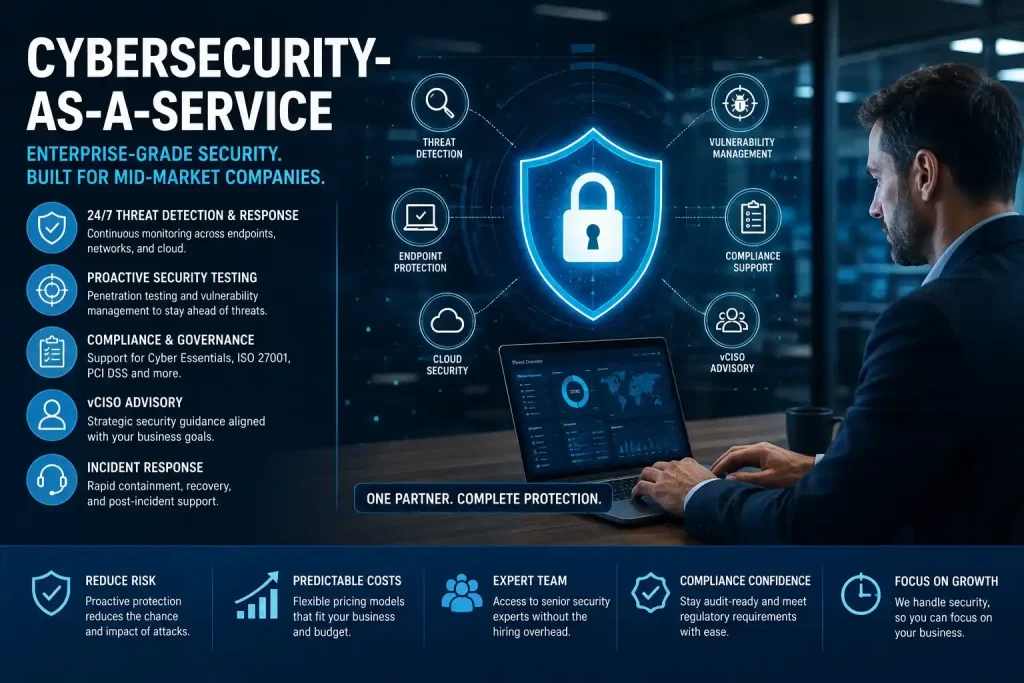
Mid-market firms, generally those with 100 to 1,000 employees, sit in an awkward spot. They’re big enough to attract serious cyber threats but too small to justify a full in-house security team.
That gap has created real demand for cybersecurity-as-a-service (CSaaS), and providers have stepped in to fill it. Below is what CSaaS actually includes, how pricing works, and what separates a genuine managed security programme from a rebranded alerting dashboard.
What CSaaS Actually Covers
At its most basic, a CSaaS contract will give you managed detection and response (MDR). That means 24/7 monitoring of your endpoints, networks and cloud environments, with a team on the other end who will act on alerts instead of just forwarding them to your inbox.
The more mature offerings go well beyond MDR. A full-stack CSaaS provider will typically bundle several services together: penetration testing, vulnerability management, compliance certification support, virtual CISO (vCISO) advisory and incident response. The idea is that one provider handles the full security lifecycle instead of you stitching together five or six separate vendors.
This matters because the attack surface doesn’t shrink just because the budget does. The UK government’s Cyber Security Breaches Survey consistently shows medium businesses report higher breach rates than small ones, so a firm with 300 employees running SaaS platforms, remote endpoints and cloud infrastructure faces many of the same commodity attacks as one with 3,000.
The difference is that they can’t hire ten specialists to cover every angle. This is where an expert cyber security firm that offers offensive testing alongside governance advisory and compliance support will earn its keep, because one contract covers testing, advisory and compliance instead of three separate vendor relationships to manage.
How Pricing Typically Works
CSaaS pricing isn’t standardised, and that will make providers tricky to compare. The three most common models are per-employee, per-asset and flat retainer.
Per-employee pricing charges a monthly fee based on headcount and usually covers endpoint protection, monitoring and basic incident response. It’s easy to budget for but will get expensive as your organisation grows.
Per-asset pricing ties the cost to the number of devices, servers or cloud instances being monitored, which tends to suit companies with a larger technical footprint but a lean team. Flat retainer models bundle everything into a single annual fee, typically covering a set number of penetration tests, ongoing monitoring, compliance support and access to a vCISO. The predictability will make planning easier.
The Maturity Spectrum: Basic Monitoring vs. Full-Stack Security
Not all CSaaS offerings are built the same, and you’ll want to know where a provider sits on the maturity spectrum before signing a contract.
At the lower end are providers who essentially resell a SIEM (security information and event management) platform with some alert triage on top. They’ll flag suspicious activity and send you a report, but you’re still responsible for deciding what to do about it. That can work if you have someone in-house with security experience, but for most mid-market companies it leaves too much on your plate.
At the higher end are providers who run a proper managed security programme. That typically includes:
- Regular penetration testing (network, web application and sometimes mobile)
- Continuous vulnerability scanning and remediation tracking
- Compliance certification support (Cyber Essentials, ISO 27001, PCI DSS)
- A vCISO who joins leadership meetings and helps shape security strategy
- Incident response with defined SLAs for containment and recovery
The gap between these two ends is significant. The lower end gives you data. The higher end will give you decisions, actions and accountability.
What to Ask Before You Sign
SLAs will tell you a lot about how seriously a provider takes their service. Ask specifically about response times for critical incidents. A good provider will commit to a defined containment window, not just an acknowledgement time. There’s a big difference between “we’ll respond within 15 minutes” and “we’ll begin containment within 15 minutes.”
You’ll also want to understand how the provider handles compliance. If your business needs Cyber Essentials or ISO 27001 certification, check whether the provider can take you through the full process or if they’re just advising from the sidelines. For Cyber Essentials, some providers are IASME-licensed Certification Bodies, which will let them prepare you and issue certification in one relationship. ISO 27001 works differently, since UKAS-accredited certification bodies have to stay independent of the consultancy work, so you’ll usually need one firm to get you audit-ready and a separate accredited body to certify you.
Finally, ask about reporting. Expect regular, readable reports that your board or senior leadership can actually use. If the provider only sends raw technical logs, that’s a red flag for a mid-market company where the CEO or CFO needs to understand the security posture without translating jargon.
Pick the Programme, Not the Platform
The CSaaS model has made enterprise-grade security accessible to companies that couldn’t previously afford it. The label alone won’t guarantee quality, though. The real value will come from providers who deliver a coordinated programme with clear accountability and a single point of contact for everything from testing to compliance.
For mid-market companies, getting this right will mean fewer surprises, a stronger compliance posture and a security function that will actually keep pace with the threats coming your way.