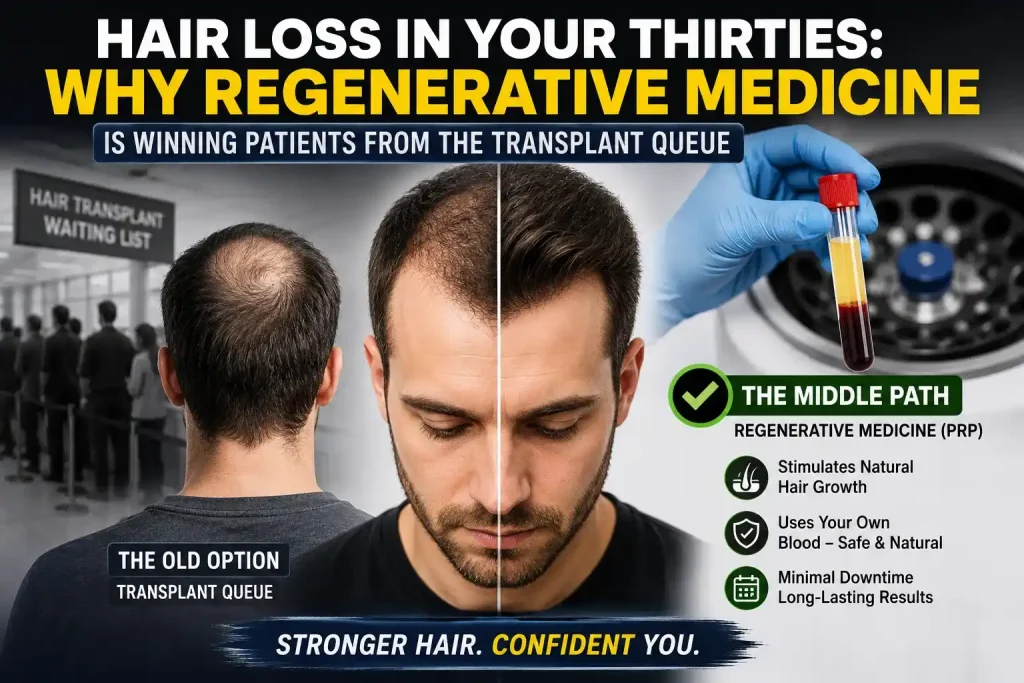
Hair Loss in Your Thirties: Why Regenerative Medicine Is Winning Patients From the Transplant Queue
Pattern hair loss announces itself earlier than most people expect — and a middle path between daily medication and transplant surgery is changing how the thinning years are treated.
There is a particular moment familiar to millions of men and a growing number of women: the photograph taken from behind, the bathroom mirror angled just so, the slow realisation that the hairline of five years ago has quietly retreated. Androgenetic alopecia — pattern hair loss — affects roughly half of men by fifty and a substantial proportion of women, and for most people it announces itself in their late twenties or thirties.
What has changed is not the condition. It is the menu of responses — and the surprising rise of a middle option between “do nothing” and “fly somewhere for a transplant”.
The old menu: a tablet, a topical and a plane ticket
For two decades, the standard options have been fixed. At one end, licensed medications: finasteride, a daily tablet that blocks the hormone DHT which shrinks follicles, and minoxidil, a topical solution or foam applied to the scalp (an oral form exists but is prescribed off-label in the UK). Both have solid evidence; both come with caveats. They work best while hair is thinning rather than gone, must be continued indefinitely to maintain results, and finasteride in particular carries side-effect considerations that make some men hesitant.
At the other end, hair transplant surgery — increasingly outsourced to overseas clinics on package deals. Transplants can produce excellent results, but the marketing rarely dwells on the fine print: surgery redistributes existing hair rather than creating new hair, a transplanted hairline in front of untreated thinning can look stranded within years, and revision surgery is expensive and sometimes impossible. Surgeons themselves increasingly say the same thing: the best transplant candidates are people who have first stabilised their hair loss.
The middle path: making the follicles you still have work harder
That word — stabilise — explains the rise of regenerative treatments, and of platelet-rich plasma (PRP) in particular. The procedure sounds almost implausibly simple: a small blood sample is taken from the patient, spun in a centrifuge to concentrate the platelets, and the resulting plasma — rich in the growth factors platelets naturally carry — is injected in tiny amounts across the thinning area of the scalp.
What separates serious providers from the rest is the engineering behind that simplicity. Preparation systems vary enormously in how many platelets actually survive processing: the better closed systems now document platelet recovery rates of 93–97% using standardised spin protocols (the Rein PRP™ system, for instance, specifies 850 G for exactly eight minutes), where cruder kits can recover far fewer — and since concentrated platelets are the entire point of the procedure, preparation quality is not a detail. Delivery matters equally: practitioners map the scalp first, then inject using the “nappage” micro-droplet technique at controlled depths of 2–4mm, concentrating on zones where follicles are actively miniaturising rather than spreading the dose thinly everywhere. Some clinics now also offer photothermal conditioning of the plasma, intended to stimulate additional growth-factor and exosome release before injection — an innovation at an earlier stage of evidence than PRP itself.
Platelet-rich plasma being prepared in a closed centrifuge system. Photo: PRP London Clinic.
The biological logic is that miniaturising follicles are not dead; they are shrinking, producing progressively finer hairs. Growth factors appear to nudge follicles back toward their active growth phase and improve the local environment around them. The clinical evidence, while heterogeneous in protocol, has accumulated to the point where meta-analyses report meaningful improvements in hair density for pattern hair loss, particularly when treatment starts early.
In practice, clinics typically recommend a course of around three sessions spaced four to six weeks apart, followed by maintenance every six to twelve months, with pricing at reputable London practices starting around £295 per hour-long session. A doctor-led PRP hair treatment will usually begin with digital trichoscopy — magnified scalp imaging that measures hair shaft diameter and follicle density — both to confirm the patient is actually a good candidate and to give later sessions an objective baseline to be judged against. Established bald areas with no surviving follicles respond poorly, which honest practitioners state plainly. The credential profile of the doctors drawn to this field is telling: at one Cavendish Square practice, lead doctor Dr Mohamed Nafei (GMC 7520509) trained in advanced PRP and exosome techniques at the Derma Institute London and — unusually for aesthetic medicine — holds a postgraduate diploma in endocrinology, the discipline governing the very hormones that drive pattern loss. The documented outcomes worth asking to see span real-world variety: crown restoration in male-pattern cases at three months, narrowing of the central parting in female diffuse thinning after a three-session course, and improved coverage in afro-textured hair, which historically has been under-served in hair-loss medicine. Because the injected material is the patient’s own blood product, allergic and rejection risks are minimal; the treatment is also drug-free, which appeals to patients wary of daily medication.
The candid comparison most clinicians offer: medication remains the evidence heavyweight, PRP is the drug-free stabiliser and thickener, transplants are for redistribution once loss has stabilised — and the three are frequently combined rather than competing.
A wider regenerative turn
PRP’s rise on the scalp is part of a broader pattern in aesthetic and regenerative medicine: using the body’s own repair machinery, or biologically active molecules, rather than implants and fillers. The same growth-factor logic has produced polynucleotide injectables — purified DNA fragments used to stimulate skin repair — now commonly used around the eyes, where thin, crepey skin and dark circles resist conventional treatments; this under-eye treatment has become an increasingly requested item on London clinic menus. Different tissue, same underlying idea: repair rather than replace.
The honest checklist
For anyone in the thinning-but-not-bald window, specialists consistently recommend the same sequence:
- Get assessed early. Every option works better with more surviving follicles.
- Ask any provider what results they realistically expect for your pattern — and walk away from anyone promising regrowth of long-bald areas without surgery.
- Verify medical credentials. In the UK, a doctor’s GMC number can be checked on the public register in thirty seconds.
- Treat “maintenance” as part of the price. Hair loss is chronic; every effective response is ongoing.
The transplant queue is not going anywhere. But the most significant shift of the past five years is that fewer patients are joining it by default — because the years when hair can still be saved are finally being treated as the window that matters.